Diffraction
and Interference of Light
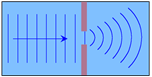
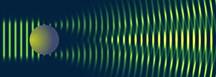
Diffraction of light is the bending and spreading of light
waves around sharp edges or corners or through small openings.
Young’s
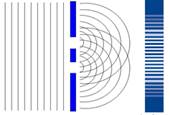
Double-Slit Interference Experiment
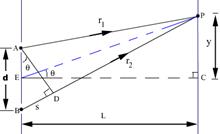
For the nth
constructive interference, the difference in the travel distances of two waves
is:

At small angle,

Therefore,

where
 is the wavelength
Single-Slit
Interference Experiment
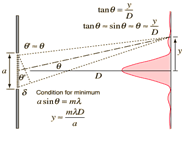
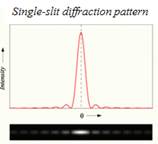
When conditions for destructive
interference, the distance of dark lines to the center is:

where m is an integer number,  is the wavelength, D is the distance between
the slit and wall, and
 is
the length of the slit opening
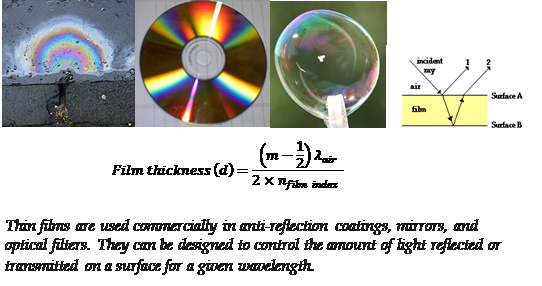
Thin-Film
Interferences
Examples:
1. Violet
light falls on two slits separated by 2×10⁻⁵ m. A first-order bright band appears 15 mm
from the central bright band on a screen 0.60 m from the slits. What is the
wavelength of the violet light?
Answer:

2. Yellow
light with a wavelength of 590 nm passes through a slit of width 0.10 mm and
makes a pattern on a screen. If the width of the central bright band is 2.0×10⁻² m, how far is it from the slit to the
screen?
Answer:




3. Light
with a wavelength of 4.5×10⁻⁵ cm passes through a single slit and falls
on a screen 100 cm away. If the slit is 0.015 cm wide, what is the distance
from the center of the pattern to the first dark band?
Answer:

4. Monochromatic
light with a wavelength of 425 nm passes through a single slit and falls on a
screen 75 cm away. If the central bright band is 0.60 cm wide, what is the
width of the slit?
Answer:


5. An
anti-reflective coating, n
= 1.2, is applied to a lens. If the thickness
of the coating is 125 nm, what is/are the color(s) of light for which complete
destructive interference will occur? Hint: Assume the lens is made out of glass.
Answer: 


 (Orange light)

 (UV
light)