Refraction of Light and Lens
The refraction of light occurs when
light passes from one medium to another with different speeds. Light rays will
bend toward the normal of the boundary in denser mediums. The amount of bending
depends on the indices of refraction of the two media and is described
quantitatively by Snell's Law.
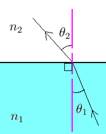

Where n1,
n2 are the refraction indices of two media and  are
the angles to the normal of boundary in two media.
Total Reflection of Light:
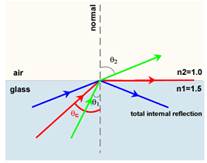
According to Snell's Law,  if
the refraction angle is 90o and
 .
This angle is called the critical angle
of total reflection. In order to have total reflection, light has to travel from a dense medium to a less dense medium such as from
water or glass to air. The higher the refraction index, the easier it is to
have total reflection of light. Total reflection of light is the main principle
behind the fiber optic transportation of data.
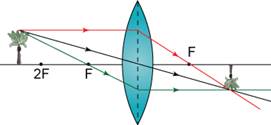
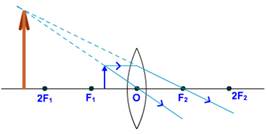
Convex Lens
·
Real
Images
·
Virtual
Images
Concave Lens
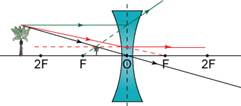
The Thin Lens Equation
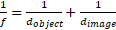
where  is
the focal length (focal length is a positive value for a converging lens and a
negative value for a diverging lens), dobject is the object
distance, and dimage is the image distance (a positive value for a
real image and a negative value for a virtual image)
Examples:
1. A
laser beam in air is incident upon ethanol (nethanol
= 1.36) at an angle of incidence of 30°. What is the angle of refraction?
Answer:

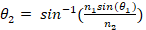 =

2. An aquarium tank is constructed from a thick sheet of plastic, n = 1.5. Light reflected from a fish in the
water has an angle of incidence of 30°. At what angle does the light enter the
air?
Answer:

 =

 =

3. A
diamond’s index of refraction for red light, 650 nm, is 2.410, while that for
blue light, 430 nm, is 2.450. Suppose that white light is incident on the
diamond at 30°. Find the angles of refraction for red and blue light.
Answer: 
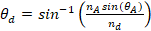
For the red light:

For the blue light:

4. The
index of refraction of crown glass is 1.53 for violet light, and 1.51 for red
light.
a.
What is the speed of violet light in crown
glass?
Answer:


b.
What is the speed of red light in crown
glass?
Answer:

5. The
ray of light shown in the figure is incident upon a 60°-60°-60° glass prism,
n = 1.5.
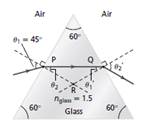
a.
Using Snell’s law of refraction, determine
the angle  to
the nearest degree.
Answer:


b. Use
elementary geometry to determine the value of  .
Answer: 


6. A
2-cm-tall object is 8 cm to the left of a convex lens of 5 cm focal length.
Find the image position and height.
Answer: 



7. Calculate
the image position and height of a 2-cm-tall object located 20 cm from a convex
lens with a focal length of 5 cm. What is the orientation of the image?
Answer:

 (inverted image)
8. A
stamp collector wants to magnify a stamp by 5 when the stamp is 3 cm from the
lens. What focal length is needed for the lens?
Answer:

