Electric
Force
Two charges attract each other when
their charges are of opposite type. Two charges repel each other when their
charges are the same type. Each charge will have a force of equal magnitude but
in an opposite direction (Newton’s third law).
Coulomb’s
Law

Where  is the electric force in Newtons,
  and
and are
charges in coulombs,
are
charges in coulombs,  is the distance in meters, and
  is
constant
is
constant )
)
Examples:
1.
Two charges,  and
and , are separated by a distance
  and
exert a force
and
exert a force  on
each other. Analyze Coulomb’s law and identify what new force would exist under
the following conditions.
on
each other. Analyze Coulomb’s law and identify what new force would exist under
the following conditions.
a.
is
doubled.
Answer:
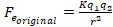

If  is
doubled,
then the new force is doubled.
is
doubled,
then the new force is doubled.
b.
and  are
cut in half.
are
cut in half.
Answer: 
If and  are
cut in half, then the new force is
are
cut in half, then the new force is  of the original force.
is
tripled.
Answer: 
is
cut in half.
Answer: 
e. is
tripled and is
doubled.
Answer: 
2.
Two identical positive charges exert a
repulsive force of 6×10⁻⁹ N when separated by a distance of 3×10⁻¹⁰ m. Calculate each of the charges?
Answer:

3.
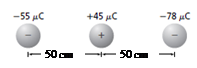 Three
particles are placed in a line as shown in figure:
Three
particles are placed in a line as shown in figure:
a.
Find the net force on the middle particle.
Answer:
 , left
 , right
 , right
b.
Find the net force on the right particle.
Answer:  , right
, left
 , left
4.
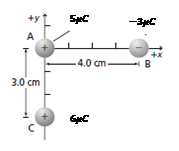 Three
charged spheres are located at the positions shown in the figure. Find the total force on sphere B.
Three
charged spheres are located at the positions shown in the figure. Find the total force on sphere B.
Answer:  , left
 =
=


x-component of 
y-component of 
 , left
 , down


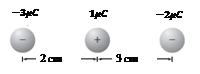
5. A positive charge of 1.0  C is
pulled on by two negative charges as shown in the figure.[DM4] One
negative charge, −3.0
C is
pulled on by two negative charges as shown in the figure.[DM4] One
negative charge, −3.0  C, is
0.020 m to the west, and the other, −2.0 C, is
0.030 m to the east. What is the total force exerted on the positive charge?
C, is
0.020 m to the west, and the other, −2.0 C, is
0.030 m to the east. What is the total force exerted on the positive charge?
Answer:



6.
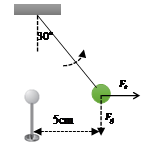 Each
of the two pith balls shown in the figure has
a mass of 1.0 g and an equal charge. One pith ball is suspended by an
insulating thread. The other is brought to 5.0 cm from the suspended ball. The
suspended ball is now hanging with the thread forming an angle of 30° with the
vertical. The ball is in equilibrium with FE, Fg, and FT. Calculate each of the following:
Each
of the two pith balls shown in the figure has
a mass of 1.0 g and an equal charge. One pith ball is suspended by an
insulating thread. The other is brought to 5.0 cm from the suspended ball. The
suspended ball is now hanging with the thread forming an angle of 30° with the
vertical. The ball is in equilibrium with FE, Fg, and FT. Calculate each of the following:
a.
Fg on the suspended ball
Answer: 

b.
FE
Answer:


c.
The charge on the balls
Answer:
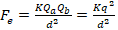
 =
= 
