Chapter 8 Electricity
Static Electricity
Protons have positive (+) charges.
Electrons have negative (-) charges. Neutrons have no charge. The charge of one proton
is equal to the charge of one electron. A basic unit of electron
charge is  C. The coulomb (symbol C)
is the SI unit of electric charge.
Static electricity is electricity that
does not flow in a current. Static electricity can be generated by rubbing two
nonmagnetic materials together.
More charge is
distributed at the sharper edges of conductor surfaces.

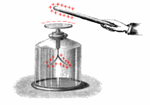
An electroscope is an instrument for detecting the presence of
static electricity. A gold leaf electroscope
is shown here:
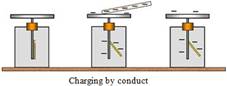
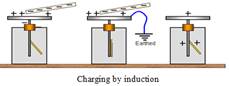
Methods of charging an object:
1. Charging by contact
2. Charging by induction
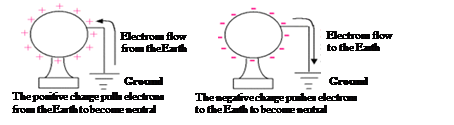
Grounding
Examples:
1.
A metal (conducting) sphere having an
excess elementary charge of +10 is brought into contact with an identical
sphere having an excess elementary charge of +16. After contact, what is the
excess elementary charge on the first sphere?
Answer: The excess charge will be
distributed evenly.

2. If
a positively charged rod is brought near the knob of an uncharged electroscope
without touching it, the leaves will diverge because
a) negative
charges are transferred from the electroscope to the rod.
b)
negative charges are attracted to the knob
of the electroscope.
c)
positive charges repel the leaves of the
electroscope.
d)
positive charges are transferred from the
rod to the electroscope.
Answer: (b) Negative charges will be transferred from
the leaves to the knob because of the attraction of the positively charged rod.
3. A conducting sphere has a net charge
of 4.8×10⁻¹⁷ C. What is the approximate number of excess
electrons on the sphere?
Answer:
Number of Electrons 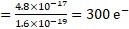
4.
Explain what happens to the leaves of a positively
charged electroscope when rods with the following charges are brought close
to, but not touching, the electroscope.
a. Positive
Answer: The leaves will move
farther apart.
b. Negative
Answer: The leaves will drop slightly.
5.
A strong lightning bolt transfers about 25
C to Earth. How many electrons are transferred?
Answer: Number of Electrons 