Chapter 4 Impulse and Momentum
Conservation of Momentum
Momentum
can be defined as "mass in motion". All objects have mass, so if an
object is moving, then it has momentum. You can consider momentum to be an
object’s resistance to stopping. It's a kind of inertia for moving an object.

Considering
a collision between two objects, and according to Newton’s third law, the
forces acting between the two objects are equal in magnitude but opposite in
direction. Since two objects experience the collision within the same period of
time, the impulses acting between the two objects are also equal in magnitude
but opposite in direction. Therefore, the momentum changed will be equal in
magnitude but opposite in direction. The overall momentum will not be changed
and the total momentum is conserved.
Law of Conservation of Momentum
Momentum
is conserved in a system if no external force acts upon it. The total momentum
before the events, such as collisions or explosions, is equal to the total
momentum after the events.
1. The key of solving momentum problems
is to find the total momentum before and
after and to solve them algebraically by setting them equal.
2. Elastic and Inelastic Collisions
An
elastic collision is defined as one where there is no loss of kinetic energy in the collision. Both momentum and kinetic energy are conserved during the elastic
collisions. An inelastic collision occurs when two colliding objects stick together after the impact. Only
momentum is conserved during an inelastic collision.
3. When object A and object B collide elastically:

Where
 are
the relative velocities of object A and B to the velocity of the center of mass.

Velocity
of the center of mass is constant under no external force condition.
Two-Dimensional Collision
Since
momentum is a vector quantity, you need to set up conservation of momentum in
both the horizontal (x−direction)
and the vertical (y−direction)
directions.
Examples:
1. A
0.01-kg bullet moving horizontally at 200 m/s crashes into a stationary 2.99-kg
block on a level and horizontal surface.
a.
What is the speed of the bullet/block
combination after the perfectly inelastic collision?
Answer: The total momentum before is equal to the
total momentum after.
0.01 × 200 + 0 = (0.01 + 2.99) × v

b.
How much energy is lost in the
collision?
Answer: Energy Lost = Energy Before — Energy After
Energy Lost =  =199.33 J
2. A
bullet with a mass of 0.008 kg (8.0 grams) is fired horizontally into a
stationary 9.0-kg block of wood on a frictionless horizontal surface. The
bullet sticks into the block of wood and the block has a speed of 0.4 m/s after
the impact. What is the initial velocity of the bullet?
Answer: Use the law of conservation of momentum.
0.008 × v + 0 = (9 + 0.008) × 0.4
v = 450.4 m/s
3. A
4-kg block moving at 20 m/s collides elastically, head-on, with an initially
stationary 6-kg block. What are the speeds and directions of the two blocks
after the collision?
Answer: Velocity of Center of Mass =  = 8 m/s

For 4-kg block: 
 m/s
For 6-kg block: 0—8 + = 0
 m/s
4. A
bullet with a mass of 0.050 kg and an initial velocity of 200 m/s is shot
horizontally at a 2-kg block suspended as shown below. The bullet becomes
imbedded in the block.
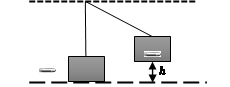
a.
Calculate the velocity of the
bullet-block system just after the impact.
Answer: Use the law of conservation of momentum.
0.05 × 200 + 0 = (2 + 0.05) × v’
v’ = 4.88 m/s
b.
Calculate the kinetic energy of the
bullet-block system just after the impact.
Answer: 
c.
Calculate the maximum height to which
the bullet-block system swings.
Answer: Mechanical energy is conserved after the
impact.
24.39 = 2.05 × 9.8 × h
h = 1.21 m
5. A
1-kg air hockey puck traveling at 2 m/s collides with a 2-kg puck. The two
pucks move off after the collision as indicated in the diagram below. Determine
the final velocity of each puck.
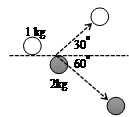
Answer:
Use conservation of momentum for both x
and y directions.
For x—direction: 2 × 1 + 0 = 
For y—direction: 0 = 
 and
