Two-Dimensional
Motion
Relative Velocity
The relative velocity  is the velocity of an object B relative to object A;
it is also is the velocity when object A observes object B.
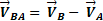
Where  and
 are the velocities of object B and A to the ground
Examples:
1. Two
highways intersect at a right angle. A car is 600 m north of the intersection
moving south at 60 km/h. A police car is 800 m east of the intersection moving
west at 80 km/h. At this moment, what is the velocity of the motorist relative
to the police car?
Answer: The velocity of the motorist relative to the
police car: 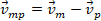
| |
=
 km/h
Angle =  =
 (south
of east)
2. Snow
is falling vertically at a constant speed of 8 m/s. At what angle from the
vertical do the snowflakes appear to be falling as viewed by the driver of a
car traveling on a straight road at a speed of 50 km/h?
Answer:
Convert to right unit first:
|
50
km |
1
hour |
1000
m |
|
hour |
3600
seconds |
1
km |
50 km/h = 

 = 60°
3. An
airplane flies between two cities. City 2 is 500 km due east of city 1. The
plane has an air speed of 250 km/h. There is a 125 km/h crosswind due north at
cruising altitude. What direction must the plane fly in order to reach city 2?
How long does the trip take?
Answer:
We need the combined velocity,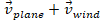 ,
pointing to the east direction from city 1 to city 2.
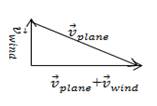
According to the diagram of three vectors above:
Combined Velocity =  = 216 km/h
Time to reach city 2:  = 2.3 hours
Direction of the plane:  = 30o (south
of east 30o)
4. A
woman can row a boat 4.0 mph in still water. She decides to row her boat in a
river where the current is 2.0 mph. Imagine she rows parallel to the bank of
the river (does not cross the river).
a.
How long would it take her to row 2.0
miles down to the river and then back to her starting point?
Answer:
We need to find out the combined velocity
of the boat and the current.
Down to the river:
 = 4 + 2 = 6 mph
 hours
Up to the river:
= 4 — 2 = 2 mph
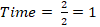 hour
Total Time = 1 +  =
 hours = 80 minutes
Now, imagine she
wishes to reach a point across the river, directly opposite to her starting
point.
b.
In what direction will her boat be headed
if she wants to reach a point directly opposite to her starting point?
Answer:
We need the combined velocity, ,
which directly points to a position across the river, directly opposite to her
starting point.

According to the diagram of three vectors above:
Direction
=  = 30o (West of north 30o)
c.
If the river is 4.0 miles wide, how long
will it take her to cross the river?
Answer: Combined velocity,||,
=  =

Time =  = 1.15 hours
d.
If she wants to cross the river in the
shortest amount of time, in what direction should she head her boat and what
direction does the boat actually travel?
Answer:
To cross the river in the shortest amount
of time, the boat’s direction needs to be perpendicular to the river bank so
that velocity in that direction is the largest.
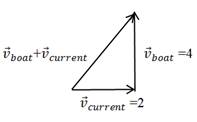
According to the diagram of three vectors above:
Direction of the boat travel:  = 26.6° downstream of the vertical line
Projectile Motion
Use
the following guidelines to solve any projectile motion:
1. The key of solving projectile motion
problems is to decompose the vector of initial velocity into two perpendicular
components, vertical and horizontal, and solve them with one-dimensional
kinetics equations independently. Projectile motion has an acceleration of –
9.8 m/s2 in a vertical direction and 0 , a
constant velocity, in a horizontal direction.
2. A projectile motion launched at an
initial velocity of  at a launch angle of θ has
the horizontal component of initial velocity
 and the vertical component of initial velocity
 .
3. Projectile motions in horizontal and
vertical directions are independent, except that they use the same amount of
time. Time is the link between the horizontal and vertical directions of the
projectile motions.
4. Remember to use the concept that the
vertical component of velocity is 0 when the object reaches the highest point.
You can find the height of this launch and the time it takes to reach the top.
5. Use the sign consistently. Normally,
use positive sign for the UP direction and negative sign for the DOWN
direction.
6. Use a table to help you solve a projectile
motion more easily.
|
|
|
vf (m/sec) |
d
(m) |
a
(m/sec2) |
t
(sec) |
|
Vertical |
|
|
|
-9.8 |
|
|
Horizontal |
|
|
|
0 |
|


Examples:
1.
A
shot put is thrown horizontally off of a wall at 12 m/s. It lands on the ground
1.5 seconds later.
a.
How
high is the wall?
Answer:
To find the height of the wall, use the
vertical component of the projectile motion.
Vertical direction:
|
vi (m/sec) |
vf (m/sec) |
d (m) |
a (m/sec2) |
t (sec) |
|
0 |
|
|
—9.8 |
1.5 |

b.
How
far away horizontally does it hit?
Answer:
To find the distance, we use the
horizontal component of the projectile motion.
Horizontal direction:
|
vi (m/sec) |
vf (m/sec) |
d (m) |
a (m/sec2) |
t (sec) |
|
12 |
|
|
0 |
1.5 |

2.
A ball is shot horizontally from the edge
of the cliff as shown below. What is the initial velocity of the ball if it
strikes the ground at point X?
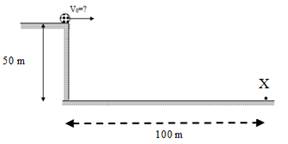
Answer: Use the vertical component to find the time to reach the ground.
Vertical direction:
|
vi (m/sec) |
vf (m/sec) |
d (m) |
a (m/sec2) |
t (sec) |
|
0 |
|
—50 |
—9.8 |
|



The
horizontal distance: 100 = 
100
= 

The
Initial Velocity = 31.3 m/s
3.
A
cannon ball is fired horizontally from the edge of a cliff 60 m high and lands
400 m away on the level ground below.
a.
How
long does it take to hit the ground?
Answer: Vertical direction:
|
vi (m/sec) |
vf (m/sec) |
d (m) |
a (m/sec2) |
t (sec) |
|
0 |
|
—60 |
—9.8 |
|

 (To hit the ground)
 (Downward)
b.
What
is the cannon ball’s initial horizontal velocity?
Answer: Use the time obtained from part a:
Horizontal direction:
|
vi (m/sec) |
vf (m/sec) |
d (m) |
a (m/sec2) |
t (sec) |
|
|
|
400 |
0 |
3.5 |

 114.3 m/s
c.
What
is the overall velocity of the cannon
ball when it hits the ground?
Answer: The overall velocity:  = 119.3
m/s
Direction =  =
 = 16.7 ° below the horizontal
4.
A football is kicked, at ground level, at a
speed of 20.0 m/s at an angle of 36.87° ( above the horizontal.
a.
How high does the ball travel?
Answer: Decompose the velocity into vertical and horizontal components:


To
find the height, use the vertical component:
|
vi (m/sec) |
vf (m/sec) |
d (m) |
a (m/sec2) |
t (sec) |
|
12 |
0 |
|
—9.8 |
|


d
= 7.35 m
b.
How long is the ball in the air?
Answer: The total time: 2 × (time to reach the highest point)
Vertical
component:
|
vi (m/sec) |
vf (m/sec) |
d (m) |
a (m/sec2) |
t (sec) |
|
12 |
0 |
|
—9.8 |
|

0 = 12 — 9.8(t)
t = 1.22s
Total of flying time: 2
× 1.22 = 2.44 s
c.
How far has it traveled when it strikes the
ground?
Answer: Use the horizontal component to find the horizontal distance R.

5.
A car is parked on the top of the hill by a
cliff. Unfortunately, the car is parked in neutral, and it begins to roll down
the hill. The hill has an incline of 10.0° below the horizontal, and the car is
traveling at 10 meters per second by the time it reaches the edge of the cliff
and begins falling. The cliff is 15.0 meters high. How far from the base of the
cliff does the car strike?
Answer: Decompose the velocity into vertical and horizontal components first:


We
need to find the time it takes to hit the ground.
Vertical
component:
|
vi (m/sec) |
vf (m/sec) |
d (m) |
a (m/sec2) |
t (sec) |
|
—1.74 |
|
—15 |
—9.8 |
|

—15 = —1.74 t —4.9t2
4.9t2
+ 1.74t —15 = 0
t
= 1.58 s
Horizontal
Distance = 1.58 × 9.85 = 15.56 m
The
car will strike 15.56 m away from the base of the cliff.