1. A person standing on
a scale inside an elevator. Suddenly the elevator accelerates downwards. The
person watching the reading of the scale will see
a) The
reading is the same as before.
b) The
reading is less than before.
c) The
reading is more than before.
d) The
reading is zero.
e) The
reading is decreasing at first then is increasing to the original number.
2. A projectile is
launched at an angle  to the horizontal with an initial velocity
 . In the absence of
any air resistance, which of the following statements is correct?
a) The
horizontal velocity increases during the flight.
b) The
horizontal velocity remains constant during the flight.
c) The
horizontal velocity decreases during the flight.
d) The
vertical acceleration increases during the flight.
e) The
vertical acceleration decreases during the flight.
Questions 3—4 refer to the following graph
below:
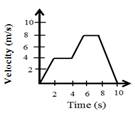
3. The approximate
acceleration between the time period 4−6 seconds is
a) 0 m/s2.
b) 2 m/s2.
c) 4 m/s2.
d) 6 m/s2.
e) —6 m/s2.
Questions 3—4 refer to the following graph
below:
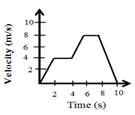
4. Which graph below
best represents the displacement of the object in the time period 6 − 8
seconds?
a)
b) 
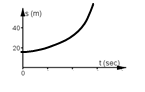
c) 
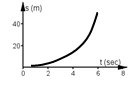
d) 
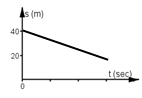
e) 
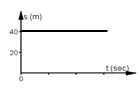

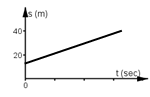
5. Ball A is projected horizontally at the same
time as ball B is released and
allowed to fall. If air resistance is negligible and both start from the same
height, then
a) A and B will reach the level ground at the same time.
b) A will reach the level ground first.
c) B will reach the ground first.
d) we
must know the mass of A and B to tell which will hit the ground
first.
e) we
must know the density to tell which will hit the ground first.
6. Which of the
following is (are) true of an object starting
from rest and accelerating uniformly?
I. Its
kinetic energy is proportional to its displacement.
II. Its
speed is proportional to the square root of its displacement.
III. Its
kinetic energy is proportional to the square of its speed.
IV. Its
velocity is proportional to the square of the elapsed time.
a) I,
II, and III only
b) I
and II only
c) II
and IV only
d) IV
only
e) I,
II, III, and IV
7. Ball A is projected vertically upward at the
same time as ball B is projected
horizontally. If air resistance is negligible and both start from the same
height, then
a) A and B will reach the level ground at the same time.
b) A will reach the level ground first.
c) B will reach the level ground first.
d) we
must know the mass of A and B to tell which will hit the ground
first.
e) we
must know the density to tell which will hit the ground first.
8. Ball A is dropped at the same time as object
Y is projected vertically upward and object Z is projected horizontally. Air
resistance is negligible. Which of the following is true?
a) Ball
A and B have the same downward
acceleration, and it is greater than Z’s.
b) Ball
A and C have the same downward
acceleration, and it is less than B’s.
c) Ball
B and C have the same downward
acceleration, and it is greater than A’s.
d) Ball
C have the same downward
acceleration, and it is less than A’s.
e) Ball
A, B, and C have the same downward
acceleration.
Questions 9—10 refer to the following
information:
The
velocity of an object as it moves along a horizontal straight line is plotted
against time as shown below.
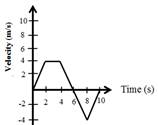
9. The distance traveled
by the object during the first 2 seconds is
a) 2 m.
b) 4 m.
c) 8 m.
d) 16 m.
e) 24 m.
Questions 9—10 refer to the following
information:
The
velocity of an object as it moves along a horizontal straight line is plotted
against time as shown below.
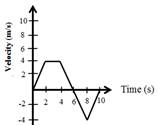
10. Find the average
speed of the object during the first 6 seconds, in meters per second.
a) 0
b) 1.33
c) 2.67
d) 3
e) 4
11. A ball is projected
vertically upward from the surface of Earth and reaches its maximum height in
4.0 seconds. Approximately what was the ball’s initial speed, in meters per
second?
a) 0
b) 20
c) 40
d) 80
e) 100
12. A ball is projected
vertically upward from the surface of Earth and reaches its maximum height in
4.0 seconds. Approximately what is the maximum height, in meters, reached by
the ball?
a) 0
b) 20
c) 40
d) 80
e) 100
Questions 13—14 refer to the following
projectile motion:
A
steel ball is projected horizontally from a certain height. It hits the ground
in 10 seconds. Assume air resistance is negligible, and the initial speed of
the object is 30 meters per second.
13. Its acceleration
during the third second is
a) 9.8 m/s2.
b) 3.2 m/s2.
c) 9.6 m/s2.
d) 32.7 m/s2.
e) greater than that
during the first second.
Questions 13—14 refer to the following
projectile motion:
A
steel ball is projected horizontally from a certain height. It hits the ground
in 10 seconds. Assume air resistance is negligible, and the initial speed of
the object is 30 meters per second.
14. The horizontal
distance traveled by the steel ball during the first 5 seconds is
a) 150 m.
b) 160 m.
c) 80 m.
d) 20.5 m.
e) 4.9 m.

15. The graph above shows
velocity y as a function of time r for a particle moving in a straight line.
Graphs of displacement s versus time t that are consistent with the y vs. t
graph above include which of the following?
I. II.
 III.

a) I only
b) III only
c) I and II only
d) II and III only
e) I, II, and III
Questions 16-17 refer to the following information:
An
object starts with a speed of 10 m/s and accelerates at −2 m/s2.
16. How much time will
pass until it comes to rest?
a) 2 s
b) 4 s
c) 5 s
d) 12 s
e) 20 s
Questions 16-17 refer to the following
information:
An
object starts with a speed of 10 m/s and accelerates at −2 m/s2.
17. How far does the
object travel before coming to rest?
a) 10 m
b) 25 m
c) 50 m
d) 75 m
e) 100 m
18. An object starts from
rest and accelerates at 3 m/s2. How far will it travel during the first
4 seconds?
a) 10
m
b) 12
m
c) 24
m
d) 36
m
e) 40
m
19. A boy standing on a
bridge throws a rock straight down and drops another rock to the river below. Neglecting
air resistance, which statement best describes the situation just as the rocks
reach the water?
a) The
acceleration of the thrown rock is greater.
b) The
acceleration of the dropped rock is greater.
c) The
acceleration of both rocks is the same.
d) The
average velocity of both rocks is the same.
e) The
final velocity of both rocks is the same.
20. Water drips from a
leaky ceiling fall at an interval of 0.4 seconds. As time passes, the distance
between two consecutive drops of water
a) decreases
in a linear manner.
b) increases
in a linear manner.
c) remains
the same.
d) decreases
in a parabolic manner.
e) increases
in a parabolic manner.
21. An object falls with
constant acceleration near the Earth. Which statement best describes the
velocity of the object?
a) The
velocity is constant.
b) The
velocity is decreasing.
c) The
velocity constantly changes in proportion to its weight.
d) The
velocity is not related to its acceleration.
e) The
velocity changes by the same amount each second.